Emergency response quick reference for guards
An emergency response card for the post: decision trees for medical calls, fire, active threats, suspicious packages and weather, each linked to its source.

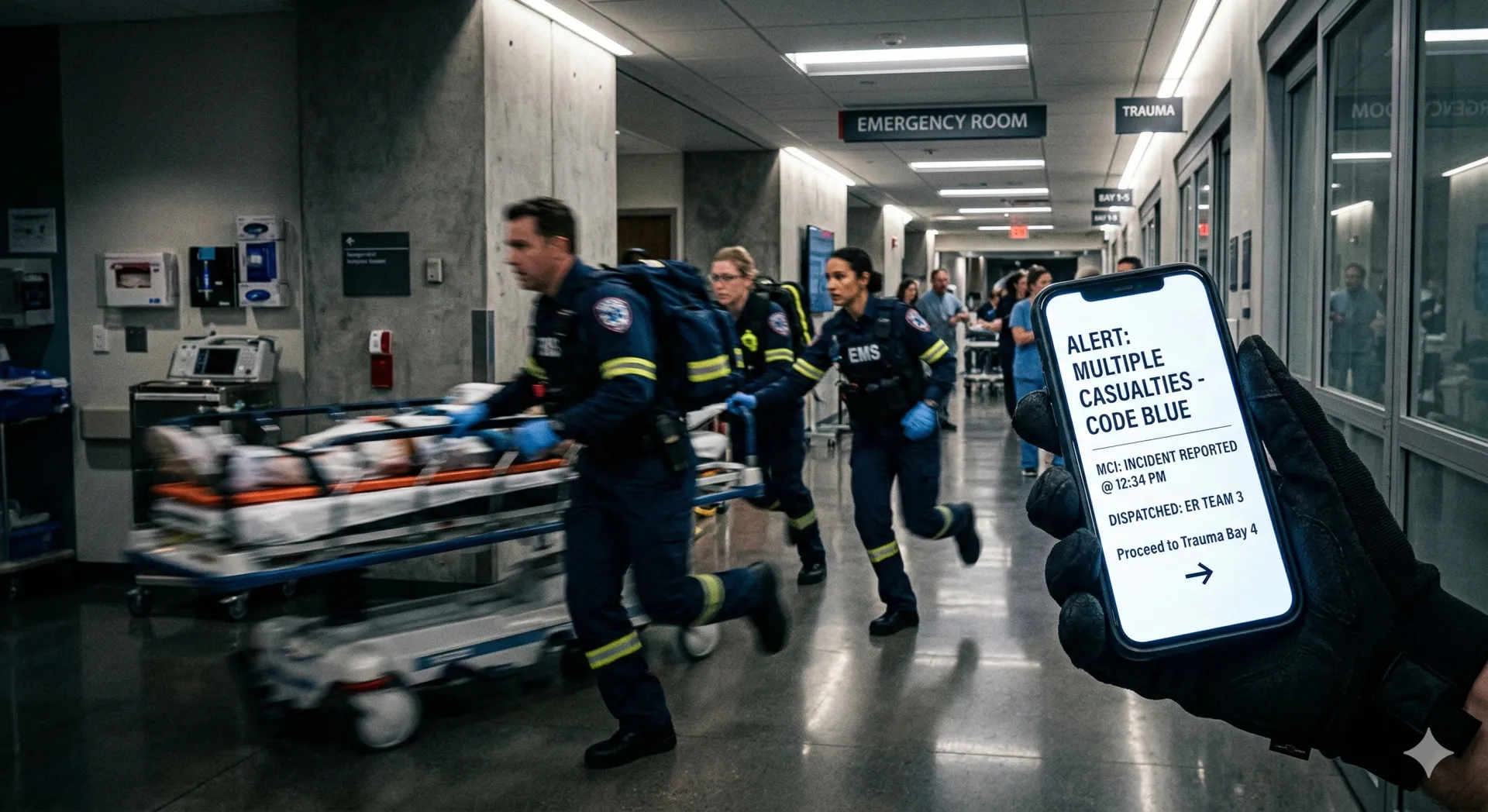
Nobody reads a binder at 0214 with an unconscious person on the floor. An emergency response reference has to fit in a shirt pocket and answer the next question. Print this, laminate it, put a copy at every post.
Every emergency runs the same five steps: assess whether the scene is safe, call for help yourself, take the immediate action, control access, and document while it is fresh. The trees below cover medical, fire, active threat, suspicious items, trespassers, building failures, weather and chemical release, each linked to its official source.
This is a reference, not training. Your site's emergency plan overrides anything here, and CPR, bleeding control and extinguisher use all need hands-on certification.
The five steps that apply to every emergency
- Assess. Is the scene safe to approach? An injured officer is a second casualty.
- Call. 911 and dispatch. Do not assume someone else did it.
- Act. Only what you are trained and equipped to do.
- Secure. Control who gets near the scene.
- Document. Times, names, what you saw, who you called.
The last step keeps getting deferred to end of shift. What you write in the first hour is what holds up later. See writing incident reports people actually read for the format.
What do you do for a medical emergency?
Is the person conscious?
- Yes: "Are you okay? What happened?" Keep them still while you get an answer.
- No: Call 911 now, then check breathing.
Are they breathing?
- Yes: Recovery position. Monitor until EMS takes over.
- No: Start CPR if trained. Send someone for the AED and say where it is.
Severe bleeding?
- Yes: Direct pressure, hard, with whatever clean material you have. Do not remove an impaled object.
- No: Keep them still and calm. Do not move them unless they are in immediate danger.
Both skills are trainable and both courses are short. The American Heart Association's Hands-Only CPR is two steps: call 911, then push hard and fast in the center of the chest. The American College of Surgeons runs Stop the Bleed for severe bleeding.
Then, in order
- 911, or hand the call to someone while you stay hands-on
- Notify dispatch and your supervisor
- Send someone to meet EMS, hold the elevator and clear a stretcher path
- Gather name, what happened, known conditions and medications
- Stay until EMS takes over, then write it down
Fire or smoke: fight it or get out?
Flames, or just the smell of smoke?
- Flames: Pull the alarm. Call 911. Evacuate.
- Smoke only: Investigate cautiously, feel doors before opening. Confirmed fire is treated as flames.
Small and contained?
- Yes, trash-can size: Extinguisher only if trained, the alarm is pulled and your exit is behind you.
- No, spreading: Leave. Close doors behind you.
Anyone trapped?
- Yes: Note the location and floor, tell the fire department at the door, do not re-enter.
- No: Account for everyone at the assembly point and report the count.
PASS, and when not to use it
- Pull the pin
- Aim low, at the base of the fire
- Squeeze the lever slowly and evenly
- Sweep the nozzle side to side
The US Fire Administration sets conditions before you pick the extinguisher up: others alerted, the fire department called, the fire confined to one object, no toxic smoke, clear escape route. Any doubt, leave and call from outside.
Active threat: run, hide or fight?
Run, first choice
- Getting away is the priority. Leave belongings behind and have a route in mind.
- Help others out if you can, and stop people walking in.
- Call 911 once you are clear.
Hide, if you cannot run
- Out of view, with a solid barrier between you and the threat.
- Lock and barricade. Heavy furniture against the door.
- Lights off, phone silenced, not on vibrate. Away from doors and windows.
Fight, last resort only
- Only when you cannot run and cannot hide.
- Disrupt the attack with whatever is to hand, and if others are there, act together.
That framing follows Ready.gov's guidance: run, then hide out of view behind a solid barrier, and fight only as a last resort.
When law enforcement arrives
- Hands visible and empty. Drop whatever you are holding, including your flashlight.
- Follow instructions exactly, and do not stop officers for help while they are clearing.
- Evacuate in the direction they tell you to go.
The first units through the door do not know your uniform. Assume they treat you as unknown until told otherwise. Where multiple agencies respond, an ICS structure the responders recognize keeps a private security force from becoming a complication.
Suspicious packages and bomb threats
What makes a package suspicious
- No return address, excessive postage, or hand-delivered with no chain of custody
- Misspellings, a generic addressee, a title with no name
- Oily stains, discoloration, an odor, or visible powder
- Rigid, lopsided, unevenly weighted, or wrapped in wire and excessive tape
- Any sound coming from it
Actions
- Do not touch it, open it, shake it, smell it or move it.
- Clear the area to the distance in your site's bomb plan. Responders will push it further.
- Call 911, then dispatch. If the plan restricts transmission near the item, move away first.
- Record who found it, when, and whether it moved.
- Wait. Nobody goes back for a closer look.
If you take a bomb threat call
- Stay on the line, keep them talking, and signal a coworker to call 911.
- Write down the exact words, not a paraphrase.
- Ask where, when, what it looks like, what will set it off, who placed it.
- Note the voice and the background noise, and whether the wording sounds read out.
- Let them disconnect first. Preserve caller ID and the line.
Keep a blank form by every phone that takes an outside call. CISA publishes a Bomb Threat Checklist capturing what law enforcement will ask for. Filling in a form beats remembering a call you took nine minutes ago.
The evacuation call is not security's alone. Management and law enforcement own it, unless a credible threat is in front of you. Put that judgment in your escalation matrix before the call comes in.
How do you move a trespasser off the property?
- Approach at a distance, angled, with your exit route open behind you.
- "Hello, I'm with security. Can I help you?" Ask why they are here and ask for ID.
- Check the visitor list or call the host before you decide anything.
- If they should not be there: "This is private property. I am asking you to leave."
- Note the time you said it. The request is the legal pivot.
- If they refuse, call the non-emergency line, or 911 if there is any threat.
- Keep your distance, put hands on nobody, and document until police arrive.
The wording and the standoff distance belong in the post orders for the site. Clients differ on this, and an officer improvising is how a trespass becomes a lawsuit.
Building failures: power and elevators
Power outage
- Flashlight only. No open flame, ever.
- Check where emergency lighting came up and where it did not.
- Radio dispatch: is it this building or the whole grid?
- Confirm the generator started, and sweep for trapped people, elevators first.
- Physically secure anything that was held by an electronic lock.
- Watch the alarm panel. Some zones run on battery and some do not.
Someone stuck in an elevator
- Talk to them on the car intercom. First contact matters more than speed.
- Tell them help is coming and the car cannot fall.
- Ask how many are inside and whether anyone has a medical condition.
- Call the elevator service company. The number is posted in the machine room.
- Do not pry the doors, and never send anyone through the roof hatch.
- Medical problem inside means 911, immediately.
Severe weather and hazardous materials
Earthquake
- During: Ready.gov's instruction is drop onto hands and knees, cover your head and neck, hold until the shaking stops. If you are inside, stay inside and avoid doorways.
- After: Expect aftershocks. Check for injuries, then gas and fire. Move away from a damaged structure. If trapped, text or bang on a pipe rather than shouting.
Tornado warning
- Ready.gov: a small, interior, windowless room or basement on the lowest level of a sturdy building, away from outside walls.
- Use your arms to protect your head and neck. Do not try to drive out of it.
Flooding
- The National Weather Service puts the number on it: six inches of fast-moving water can knock an adult over, twelve inches carries away most cars.
- Move to higher ground. Do not walk or drive through it to reach a post.
- Stay clear of anything electrical or submerged, and treat the water as contaminated.
Chemical spill or hazmat release
- Do not touch it, walk through it, or stand in the fumes.
- Outdoors, move upwind of the source and uphill.
- Indoors, get out if it is safe. If not, Ready.gov's shelter guidance is an internal room with exterior doors and windows closed and locked.
- Call 911 and name the substance if you can. The safety data sheet is on site.
- Hold the perimeter. If someone is exposed, remove what touched them and rinse with water.
How do you make this work at 0214?
Reading it once does nothing. Two things move the needle: rehearsal, and site-specific details filled in before the night they matter.
The wider version, with roles and after-action structure, sits in the incident response playbook template and crisis management for security companies.
Key Takeaways
- Assess, call, act, secure, document. In that order, every time.
- Call 911 yourself. Assuming someone else did is how a ten-minute delay happens.
- Fight a fire only if the alarm is pulled, the fire is one object, and your exit is behind you.
- Do not touch, move or transmit next to a suspicious item. Clear further than feels necessary.
- Print the site-specific numbers into the post orders. A reference with blanks is not a plan.
Continue Reading
Security escalation matrix template: who to call
A security escalation matrix template with four severity levels, notification times, named backups and call sequences for medical, fire and active threat.
Site security assessment checklist: 101 points
A 101-point site security assessment checklist covering perimeter, access control, cameras, fire safety and operations, plus how to rank what you find.
Crisis management for security guard companies
Crisis management for a guard company: classification criteria, a notification chain that runs at 2am, one spokesperson, and the record you build during it.