Hospital security: violence, access and response
What hospital security teams plan for: workplace violence in the ED, behavioral health elopement, infant abduction drills and the privacy limits on a report.

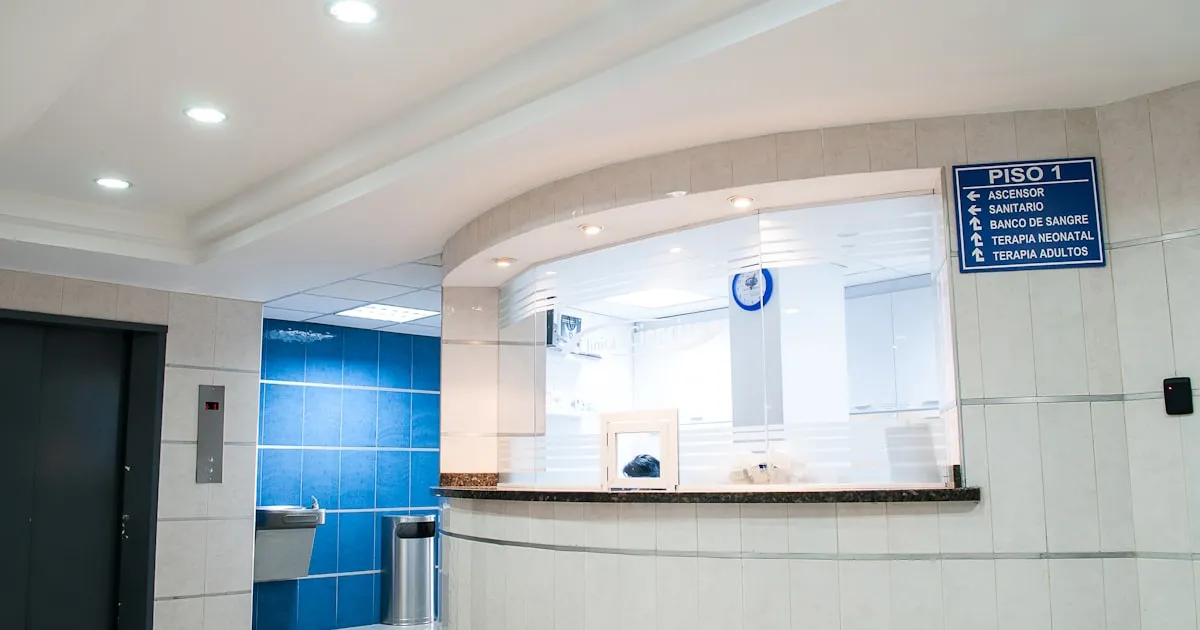
A hospital is the one site where the person you may have to restrain is also the person the building exists to help. Everything hard about hospital security comes from that sentence.
The risk concentrates in the emergency department, behavioral health and maternity, and each one needs a different posture. Officers on a hospital post need healthcare de-escalation, the facility's own privacy policy in writing, and the local code set memorized before their first shift. The state guard card does not cover any of it.
How bad is the violence problem, actually?
Worse than most operators assume, and the numbers are published.
BLS reports that health care and social assistance had the highest counts and annualized incidence rates for workplace violence of any private industry sector, at 14.2 cases per 10,000 full-time workers over 2021 and 2022, and accounted for 72.8 percent of all private industry cases in that period.
One occupational figure is worth staring at. Psychiatric aides recorded 543.6 cases per 10,000 full-time workers. That is not a slightly elevated risk. That is a different job.
The mechanism is not mysterious. People arrive in pain, in withdrawal, in psychosis, or having just been told something unsurvivable about someone they love. None of that is criminal intent, and almost none of it responds to the tone a guard would use on a trespasser in a parking lot.
Where does the risk concentrate?
Three places, and they need three different postures.
The emergency department. The only door in the building with no screening in front of it. Everything arrives here: weapons in waistbands, intoxication, undiagnosed psychiatric crisis, and families in a waiting room getting angrier by the hour with no information. If you staff one post well in the whole hospital, staff this one, with officers assigned long enough to know the charge nurses by name.
Behavioral health. The problem here is elopement as much as assault. A patient leaving a locked unit may be suicidal, and the security response has to support the clinical goal rather than overwrite it. An officer who turns the unit into a jail has damaged the treatment the unit exists to deliver. This is the hardest judgment call in the building and it is not something generic guard training touches.
Maternity and the nursery. Rare and catastrophic, which is exactly the risk profile that justifies a rehearsed procedure. The National Center for Missing and Exploited Children counts 345 healthcare-related infant abductions in the US from 1964 through January 2025, of which 140 were taken from healthcare facilities. NCMEC also describes the typical abductor: usually a female of childbearing age who appears pregnant, and who often impersonates a nurse or other clinical staff.
That profile is the reason the countermeasure is not a camera. It is staff who challenge an unfamiliar person in scrubs, electronic infant tagging tied to the exits, mother-baby matching before anyone leaves a room with a child, and a lockdown drill that has actually been run rather than written.
What can a guard say about a patient?
Less than they think, and the answer belongs to the hospital, not to you.
HIPAA governs what officers may see, record and repeat. It reaches ordinary things: whether a named person is in the building, what an officer writes in an incident report, and whether a photo of a scene can include a patient. Officers who guess here create exposure for the facility and for themselves.
Do not train your officers off a blog's reading of HIPAA, including this one. Every hospital has a privacy officer and a written policy on directory information, law enforcement requests and incident documentation. Get that policy in writing, put the relevant parts in the post orders for the site, and have the privacy officer brief new officers directly. The correct answer to a question about a patient is almost always to route it to the clinical staff.
The practical version, for the report itself: describe behavior and location, not diagnosis. "Male in room 12 became agitated, struck the door frame, was redirected by nursing staff at 02:14" is documentation. Anything about why the person was in room 12 is clinical information you are not writing down. There is more on the discipline of that in writing incident reports people can actually use.
What training does a hospital post actually need?
The state guard card is the floor, not the qualification.
Build this into the site-specific half of your program rather than the general curriculum, because it does not transfer. An officer excellent at a warehouse gate can be actively dangerous on a psychiatric unit. Structuring the training program covers how to keep the two layers separate.
One more thing that is training, not technology: officers who rotate through a hospital every few weeks never build the relationships that prevent incidents. The nurse who quietly tells the officer that room 12 is escalating, twenty minutes before it does, only does that for someone she knows.
What technology earns its place?
The systems that shorten the distance between a person needing help and someone knowing about it.
Staff duress buttons. Fixed at triage and nursing stations, wearable for staff on units. The point is summoning help without saying anything out loud, because announcing that security is coming is often what triggers the assault. Placement matters: reachable by staff, not obvious to an agitated visitor leaning on the counter.
Infant protection tagging. Electronic tags that alarm at exits and door releases that respond to them. Test them on a schedule and log the tests, because this is a system whose only failure mode is discovering it does not work during the one event it exists for.
Access control at the sensitive doors. Pharmacy, medication rooms, behavioral health, pediatrics, ORs, records. Then audit the access lists quarterly, since the real failure is not a defeated reader but forty-eight badges belonging to people who left. Access control beyond badge readers goes into that.
Officer location and duress on the officer's own device. A single guard responding to behavioral health at 3am is a lone worker by any definition. Knowing where they are, and having a way for them to call for help hands-free, is the same problem as welfare checks on any isolated post.
Video with analytics, used narrowly. Loitering near an infant unit exit, tailgating through a restricted door. Broad behavioral analytics across a hospital generates noise nobody reads. Aim it at the two or three doors where an alert would actually move someone.
None of this replaces an officer standing in the ED. It shortens the time between the moment something goes wrong and the moment the right people know. On a hospital floor that gap is measured in seconds, which is why the response plan matters as much as the equipment. Incident command structure and an emergency response quick reference are what turn an alarm into an organized response.
Key Takeaways
- BLS puts health care at the highest workplace violence rate in private industry, and psychiatric aides far above that.
- The emergency department is the unscreened door. Staff it with officers who stay long enough to know the clinical team.
- Behavioral health needs security that supports treatment rather than replacing it. Elopement is the primary risk.
- Get the hospital's own HIPAA policy in writing and into the post orders. Officers should not interpret the rule.
- Codes are facility-specific, and infant tagging needs a logged test schedule. Both are day-one items.
Continue Reading

Retail loss prevention strategies that work
What the NRF shrink numbers actually say, and the floor layout, exception reporting, officer training and outside partnerships that answer retail theft.

Event security planning: staffing to egress
Risk assessment, a staffing number you can defend, screening throughput, crowd density and the exit plan, for concerts, festivals and corporate events.

Construction site security: threats and the plan
What gets stolen from a jobsite, how to assess the risk at each phase, and how to choose between patrol, remote monitoring and a standing guard.