Night patrol best practices for overnight shifts
Night patrol best practices for fatigue, light discipline, solo response and check-ins, built on what OSHA measures about night shift risk.


Two in the morning is not eleven at night with fewer people about. On night patrol your body is at its lowest ebb, backup is twenty minutes out, and the only thing between a propped fire door and nobody noticing is you.
OSHA puts injury rates 30 percent higher on night shifts than on day shifts, and says workers generally do not acclimate to night work. What works is unglamorous: a protected sleep window, caffeine early, movement on a static post, a check-in schedule with a written miss procedure, and a plan for getting home awake.
Why is night patrol harder than the same post in daylight?
Because the risk is measured, not imagined. OSHA's fatigue guidance puts accident and injury rates 18 percent higher on evening shifts and 30 percent higher on night shifts than on day shifts. Working twelve-hour days carries a 37 percent higher injury risk on the same page.
The part most schedulers get wrong is adaptation. OSHA's guide to extended and unusual work shifts states plainly that workers generally will not acclimate to night work, and that studies suggest it can take up to ten days to adapt to a nighttime schedule. A guard who rotates onto nights for four days and back off never gets there.
So the fix is partly yours and partly your employer's. If your rotation flips every few days, that is a scheduling problem, not a willpower problem. Building a schedule guards can actually live with covers what to change on the roster side.
How do you stay alert through a night rotation?
The controls are boring and they work. Most of them happen before you ever put the uniform on.
What OSHA recommends for shift workers
- Sleep 7 to 9 hours a day, without interruption, at the same time each day
- Working evenings or nights: make sure sleep has occurred within the last 8 hours before you go on duty
- Napping before work: keep it under 45 minutes or over 2 hours, so you finish a sleep cycle instead of waking mid-cycle
- Keep the sleeping environment comfortable, cool, dark and quiet
- Avoid caffeine before bedtime, which for a night worker means the back half of the shift
Source: OSHA, Long Work Hours, Extended or Irregular Shifts, and Worker Fatigue.
That nap rule catches people out. Twenty minutes at the kitchen table before a night shift lands you in the worst part of the cycle, and you arrive groggier than if you had skipped it.
Two things OSHA does not cover that every night guard learns anyway. Blackout curtains and an eye mask do more for day sleep than any amount of discipline. And a heavy meal at 0200 will put you on the floor, so eat light and eat often.
Movement is the other lever. A static post at a lobby desk is harder to stay awake on than a walking tour, which is one argument for building a route that keeps people upright. Where you place checkpoints decides how much of the shift is spent moving.
How should you use light at night?
You want the right people to see you and the wrong people not to see you coming. Those two goals fight each other, and the flashlight is where the fight happens.
- The beam announces you. Sometimes that is the entire point. A visible sweep of a parking deck is deterrence. Approaching a noise behind a dumpster is not the moment for it.
- Protect your dark adaptation. Every time you look into your own beam or a lit doorway, you give up several minutes of night vision. Light the ground and the object, not your own eyes.
- Watch your silhouette. Standing in a lit doorway makes you the most visible thing on the property to someone standing in the dark.
- Listen more than you look. Sound carries further with less traffic and less HVAC load. A gate chain, a car door, a footfall on gravel all read clearly at 0300.
Vary the pattern too. A route walked the same direction at the same minute every hour is a published timetable for anyone watching for a week. Keep the checkpoint sequence your post orders require and vary the approach, the start point and the direction inside the windows you are given.
Batteries are the unglamorous failure here. A dead light or a dead phone at hour six ends the useful part of the shift, which is why spare cells belong on the equipment list rather than in the truck.
What do you do when backup is twenty minutes away?
You handle the first minutes alone. That is the job. It is also the reason the sequence below is fixed rather than improvised.
- Communicate before you engage. Dispatch should know where you are and what you are looking at before you get close enough for it to matter. A report made after the fact helps nobody.
- Assess from distance. How many people, hands visible or not, what they are near, and where the exits are. Thirty seconds of watching is cheaper than any of the alternatives.
- Keep the distance you have. Closing distance is always available to you. Creating it once you are inside arm's reach is not.
- Know the ceiling on your authority. Observe and report is a complete answer, and on most contracts it is the correct one. You do not have to resolve everything you find.
What separates a clean solo response from a bad one is usually whether the decision was made before the shift started. That belongs in writing, per site, with the thresholds named. A written escalation matrix is what turns "use your judgment" into something a guard can act on at 0300.
What does a night check-in schedule need?
A check-in is only worth the interval if somebody notices when it does not arrive. That second half is what most operations skip.
The miss procedure is the whole control. Without it a check-in schedule is a log of things that went fine. There is more on setting intervals and escalation ladders in welfare check-ins for lone workers, and on the automated version in lone worker monitoring.
Why is the drive home the most dangerous part of the shift?
Because it happens at the exact hour your body is least equipped for it, and because nobody supervises it.
The number is stark. In a 2005 study of 2,737 medical residents cited in OSHA's fatigue hazards page, every extended shift scheduled in a month raised that month's risk of a motor vehicle crash on the commute home by 16.2 percent. Different industry, same physiology.
Getting home is the last task of the shift. Treat it that way.
- Sleep in the parking lot before you drive if you need to. A completed nap beats a heroic drive.
- Cold air and loud music buy you a few minutes and nothing more. They are not a plan.
- If you are drifting in the lane or missing exits, you are already impaired. Pull over.
- On a long rotation, a rideshare or a transit leg costs less than the deductible.
If your company runs vehicles rather than personal cars, this belongs in the fleet policy alongside the inspection routine. See managing a patrol vehicle fleet for where that fits.
Key Takeaways
- OSHA measures injury rates 30 percent higher on nights, and says workers do not acclimate to them.
- Sleep 7 to 9 hours, within 8 hours of duty. Nap under 45 minutes or over 2.
- The flashlight announces you. Decide each time whether that is what you want.
- A check-in schedule without a written miss procedure is a log, not a safety net.
- Getting home is the last task of the shift. OSHA links extended shifts to commute crashes.
Continue Reading
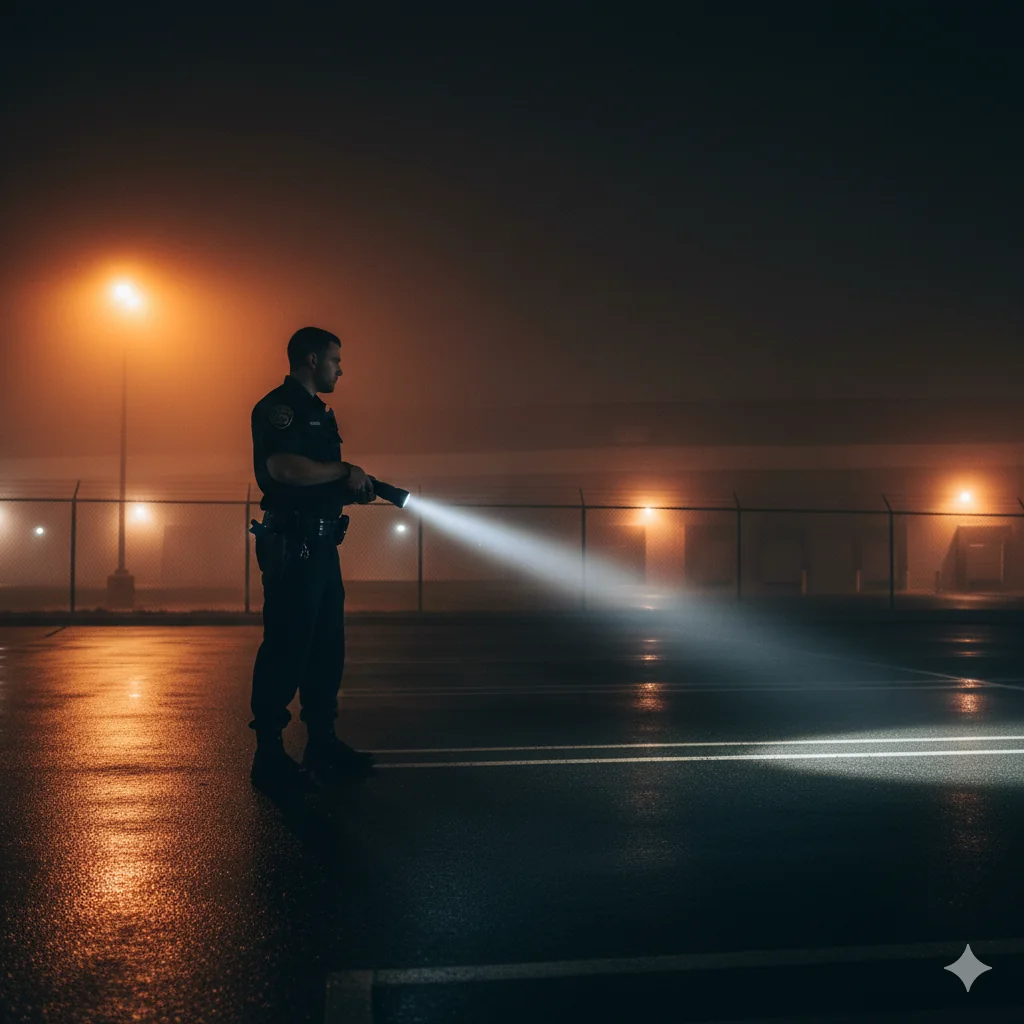
Lone worker check-ins: intervals and escalation
Welfare check-ins for lone workers: set the interval from the real hazard, route the escalation to a named person, and test it before you rely on it.
Construction site security: the daily operating routine
The habits that hold a jobsite: one gate, a signed end-of-day check, randomized patrols with checkpoint proof, and a plan re-walked at every phase change.
Parking enforcement procedures for security officers
Parking enforcement procedures for security officers: where your authority ends, warnings and citations that survive appeal, tow rules and accessible spaces.