What autonomous security patrol robots do
Security patrol robots observe, record and alert but cannot intervene. What Knightscope and Boston Dynamics publish, realistic runtime, and where a robot fits.

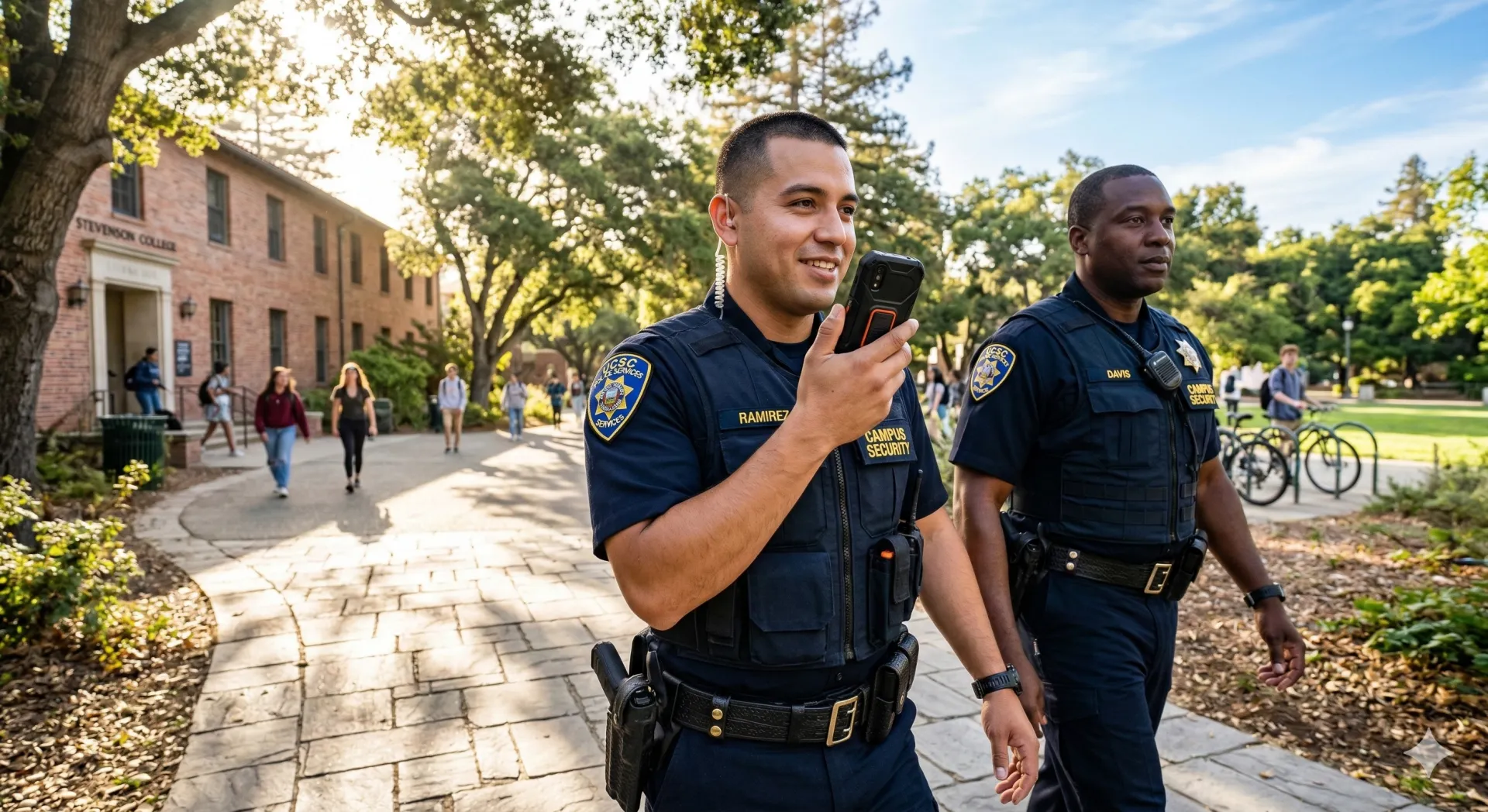
A patrol robot will cover the same parking deck at the same interval at 4am on Christmas morning without complaint. It will also stand there while someone kicks it. Both facts matter, and most buying decisions go wrong because someone only weighed one of them.
These are sensor platforms on wheels or legs. They cover fixed routes tirelessly, record video, read plates and raise alerts, and none can intervene. Runtime is shorter than people expect: Boston Dynamics publishes 90 minutes average for Spot with a 60-minute recharge. Buy one as an extension of a monitoring center, not a headcount replacement.
What can a security patrol robot actually do?
Capability varies by product, so read the spec sheet rather than the category. The current generation offers some combination of the following.
- Autonomous patrol of a mapped route. Same ground, same interval, no supervision required once the map is built.
- Continuous video. Knightscope describes its K5 as outdoor ground patrol with 360-degree HD video, thermal imaging, plate recognition and public address.
- Detection and alerting. People, vehicles, plates, heat signatures, changes from a learned baseline.
- Two-way audio. A remote operator talks through the unit. On the K5 that sits alongside broadcast messaging and quad strobe lights for deterrence.
- Environmental monitoring. Temperature, humidity and air quality, which is why data centers were an early adopter.
- Visible presence. An obviously non-human patrol unit changes behavior in a lot, at least while it is novel.
What it cannot do
None of this is a limitation you engineer around. It is the shape of the thing.
- Physically intervene. No pursuit, no restraint, no escort, no hands on anything.
- Exercise judgment about an ambiguous situation involving a person.
- Provide service beyond a scripted interaction or a live operator on the speaker.
- Handle an environment that has changed since it was mapped.
- Manage stairs and significant elevation change, on most wheeled platforms.
- Defend itself. An unattended unit in an open lot is a target, and a tamper alert only helps if somebody can get there.
What runtime should you plan around?
This is the specification that most often surprises buyers.
Boston Dynamics lists Spot at an average runtime of 90 minutes with a 60-minute recharge, along with a max speed of 1.6 m/s, a maximum slope of 30 degrees and a maximum step height of 300 mm. It self-rights if it falls and returns to charge on its own.
Wheeled outdoor units generally run longer than legged ones, and vendors handle the gap with autonomous docking rather than swappable packs. Get the number in writing for the specific model, then work out what your coverage actually looks like once charging cycles are subtracted. A unit that patrols 70 percent of the hours you are paying for is not a scandal, but it is a different purchase than the one in the brochure.
Cold, heat and heavy rain all cut runtime or stop outdoor operation entirely, and none of the marketing pages lead with that. Ask what happens at 15 degrees and what happens in a downpour, and ask for the answer by model rather than by brand.
Who is actually in this market?
The lineup changes fast enough that any list, including this one, is a snapshot. What follows is what these vendors say on their own current pages.
- Knightscope. The K5 outdoor ground patrol unit is the recognizable one. The same page references a K7 and the stationary K1 Hemisphere, alongside several products listed as in development. Pricing is not published; it is quoted.
- Boston Dynamics. Spot is sold as an inspection and sensing platform rather than a security product, which is why it turns up where terrain and stairs defeat wheels.
- OTSAW. Still lists the O-R3 for outdoor patrol with video analytics.
- Ava Robotics. Now leads with a telepresence robot and a mobile base, with security listed as one use case among healthcare and hybrid work rather than the headline.
The Cobalt story is the one to learn from
Cobalt Robotics built an indoor security robot with remote human specialists behind it. Its old domain now redirects to Cobalt AI, which sells an AI monitoring platform that overlays onto cameras and access control you already own, plus a managed operations center. The robot still exists in the lineup as one data source feeding the platform.
That is a company concluding, in public, that the valuable part was the monitoring intelligence rather than the machine. Worth sitting with before you sign a multi-year hardware commitment. If what you actually want is eyes on more cameras, video analytics and remote monitoring paired with a mobile patrol may get you there without a robot at all.
Where does a robot earn its keep?
| Good fit | Why |
|---|---|
| Large parking structures | Flat, mapped, repetitive, and the least interesting hours of a guard's shift |
| Data centers | Environmental monitoring rides along with the patrol, and the layout never changes |
| Mall common areas after close | Nobody left to interact with, and the route is fixed |
| Office lobbies alongside a guard | The robot covers the sweep so the human stays at the desk |
| Warehouses and distribution yards | Defined paths, long perimeters, stable layouts |
Poor fits are the mirror image: anywhere that needs real human interaction, anywhere the layout moves week to week, anywhere with stairs or rough ground, and anywhere the plausible incident requires someone to physically do something. Add one more, the one that sinks deployments quietly: any operation with nobody to answer the alert the robot generates.
What does the investment actually involve?
Robot economics do not look like guard economics, which is what makes the comparison so easy to get wrong.
- Acquisition or subscription, quoted rather than listed
- Site survey and mapping, which is the part that determines whether it works
- Charging infrastructure, power runs and dock placement
- Maintenance, repair and eventual hardware replacement
- Connectivity across the whole route, not just near the building
- Monitoring: somebody, somewhere, watching the alerts it produces
Against that, a robot does not call out, does not take a break, does not accrue overtime, and does not resign after eleven weeks. It also does not walk a visitor to their car, does not calm anyone down, and does not make a call about whether the man by the loading dock is a threat or a driver on a smoke break.
The honest comparison is not robot versus guard. It is "robot plus monitoring" versus "another guard," and the answer depends almost entirely on whether the hours you want covered are repetitive and uneventful. If they are, the machine competes well. If anything happens on those hours, you still need the person.
What does deployment actually require?
Do not skip the people part
Reaction to a patrol robot is not uniform. Some tenants find it reassuring and some find it unsettling, and constant video recording in shared space raises privacy questions that will reach you through the property manager rather than through a policy document. Brief the client's community before the unit arrives, not after the first photo goes up online.
Where is this heading?
Sensors, navigation and detection keep improving, and the same operators evaluating robots are usually also evaluating drones for the same perimeter. What has not changed, and shows no sign of changing, is the division of labor: these are observation platforms, and response is still a person.
The Cobalt pivot suggests where the value is actually settling. Not in the machine that moves, but in the layer that decides which of the night's events a human should look at. If you are picking a direction to invest in, that is the one worth watching.
Key Takeaways
- Patrol robots observe, record and alert. They cannot intervene, and no roadmap changes that.
- Runtime is short. Spot is published at 90 minutes average with a 60-minute recharge.
- Repetitive, uneventful, mapped routes are the fit. Interaction and stairs are not.
- Vendor pricing is quoted, not published. Verify specs against the vendor's own current page.
- A robot with nobody watching its alerts is a very expensive camera on wheels.
Continue Reading
Drones in security operations: rules and uses
Where a security drone beats a guard on foot, what FAA Part 107 requires of the pilot and aircraft, and the recording consent you need before the first flight.

Security operations trends for 2026: pay and data
Security operations trends for 2026: guard pay now matches warehouse work, clients buy reporting in the RFP, and paper is still the real technology gap.

How to win security contracts with technology
Buyers want proof a patrol happened. Put GPS-verified routes and same-day reports in the bid, demo them live, and answer a cheaper offer with evidence.